
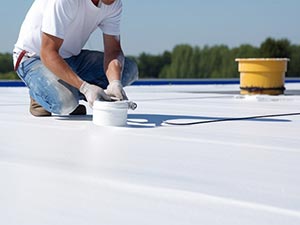
Most commercial building owners think of a roof coating as a waterproofing product. It is that, but on a New Town commercial building it does considerably more. Elastomeric roof coatings in New Town, ND, protect the membrane beneath from UV breakdown, reduce rooftop heat transfer into the building, and add years of service life to an existing roof that would otherwise be approaching replacement territory.
At Eagle Eye Roofing, we apply elastomeric coating systems on commercial roofs across New Town and the surrounding North Dakota region. Call us at (701) 202-7280 to find out what a coating system can do for your building.
This article covers the full value picture of elastomeric roof coatings on New Town commercial buildings, including reflectivity, UV protection, and membrane life extension, and why building owners who look at coatings only as a leak fix are leaving most of the value on the table.
Elastomeric Roof Coatings: Beyond Waterproofing
A properly applied elastomeric coating creates a fully adhered, seamless membrane over the existing roof surface. It seals minor cracks and surface voids, reinforces lap edges, and bridges small areas of surface degradation that would otherwise allow moisture entry over time. That waterproofing function is the most visible benefit, but on a North Dakota commercial roof it is not the most significant one. The greater value comes from what the coating does to the surface environment the existing membrane lives in. Left uncoated, a commercial roof membrane in New Town absorbs UV radiation across every summer day, oxidizes, loses flexibility, and moves steadily toward a failure condition. A reflective elastomeric coating intercepts that process by shielding the membrane from the UV and thermal cycling that drives deterioration.
UV Protection
North Dakota sits at a latitude where summer UV intensity is significant, and the open terrain around New Town means commercial roofs receive direct solar exposure without urban shading. UV radiation is the primary mechanism behind membrane oxidation, the process that makes roofing membranes stiff, brittle, and prone to surface cracking over time. An elastomeric coating formulated with UV-resistant polymer chemistry acts as a sacrificial layer between the UV source and the membrane, absorbing and reflecting solar radiation before it reaches the substrate. It degrades slowly over its service life by design, taking the UV exposure that would otherwise work on the membrane directly. When the coating reaches the end of its service life, it can be cleaned and recoated, renewing protection without disturbing the membrane beneath.
Reflectivity and Energy Performance
A white or light-colored elastomeric coating reflects a significant portion of solar radiation away from the building rather than absorbing it. On a dark commercial membrane in summer, rooftop surface temperatures can reach extreme highs on a clear day in western North Dakota. That surface heat transfers through the roof assembly into the building interior, increasing the cooling load on HVAC systems. A reflective coating reduces that heat transfer at the source. Building owners who have installed quality reflective coatings on commercial properties in similar climates consistently report measurable reductions in summer cooling consumption, particularly on buildings with significant roof area relative to total square footage. The summer cooling benefit compounds across every cooling season for the life of the coating.
Extend Membrane Life
The thermal cycling that commercial roofs experience daily in North Dakota is one of the most damaging forces working on a membrane over time. As the roof surface heats through the day and cools at night, the membrane expands and contracts. Over years, that movement fatigues the material at seams, laps, and areas where the membrane is restrained by a fastener or flashing detail. An elastomeric coating with good elongation properties moves with the membrane rather than resisting its movement, reducing stress concentration at those fatigue-prone locations. On an older membrane that still has structural integrity but is showing surface wear, a properly applied elastomeric system can realistically add significant years of service life, allowing the building owner to plan replacement on their schedule rather than in response to an emergency.
Get the Full Value of Elastomeric Roof Coatings
Elastomeric roof coatings on New Town, ND commercial buildings deliver more than a sealed roof. They deliver UV protection, reduced thermal load, extended membrane life, and a renewable protection system that works across North Dakota’s demanding climate year after year. At Eagle Eye Roofing, we assess commercial roofs across the region and apply coating systems that are matched to the existing membrane and the building’s specific needs. Call us at (701) 202-7280 and let us show you the full picture of what a coating system delivers.
FAQ
Can an elastomeric coating be applied over any existing roof membrane in New Town?
Compatibility between the coating and the existing membrane must be confirmed before application, and a dry, well-adhered substrate is required for the system to perform as warranted.
What is the best time of year to apply an elastomeric coating in North Dakota?
Late spring through early fall is the practical window in North Dakota, as most elastomeric coatings require ambient temperatures consistently above 50 degrees Fahrenheit for proper curing.
How long does an elastomeric roof coating last on a North Dakota commercial building?
Quality systems on properly prepared roofs typically carry 10 to 15 year warranty terms, with performance extending further on roofs that receive periodic maintenance inspections.
Can an elastomeric coating be reapplied at the end of its warranty term?
Yes, elastomeric systems are designed to be cleaned, primed if necessary, and recoated at the end of the coverage period to renew the warranty without removing the existing coating.