
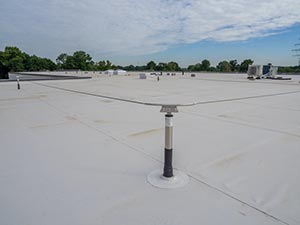
North Dakota winters do not announce what they are doing to your roof. Snow piles up, temperatures drop hard, and whatever damage is accumulating beneath that snowpack stays invisible until the thaw arrives. Scheduling roof leak detection in New Town, ND, after a long winter is not a precaution. It is the most important roofing call a property owner can make.
At Eagle Eye Roofing Systems, we perform leak detection on commercial roofs. Call us at 701-202-7280 as soon as conditions allow and let us find what the winter left behind.
The Hidden Damage Roof Leak Detection Finds
Here is the problem with North Dakota winters and roofing: snow is an insulator. A thick snowpack sitting on a commercial or residential roof through January and February is concealing whatever is happening at the membrane surface beneath it.
What makes this worse is that some of those failures are actively allowing water infiltration while the snow is still in place. Melt water from the upper roof surface travels beneath the snowpack, finds a breach point in the membrane, and moves into the insulation layer below. By the time spring arrives and the roof surface is visible again, that moisture has been sitting in the assembly for weeks. Insulation that has absorbed water cannot dry out on its own. It holds that moisture against the deck and interior structure indefinitely.
This is the hidden cost of delayed roof leak detection.
Freeze-Thaw Cycling
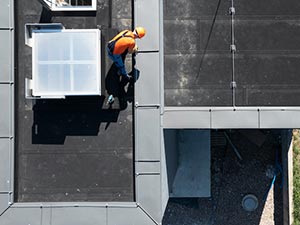
The freeze-thaw cycle is the most damaging force a North Dakota roof faces across a full winter. Temperatures in the New Town area swing repeatedly across the freezing point through late fall, early spring, and even mid-winter thaw events. Every time that happens, water that has worked its way into a small crack, a compromised seam, or a failing flashing joint expands as it freezes and contracts as it thaws.
On a flat or low-slope commercial roof, those micro-expansions at seam points accumulate over an entire season. A seam that was tight in October may have a gap by March. Flashing that was sealed at the base of a parapet wall may have pulled free at a fastener point by February. EPDM membrane that was flexible in September loses elasticity in sustained sub-zero temperatures and can crack at stress points it handled fine the previous summer.
None of these failures produce an immediate, visible interior leak in most cases. They produce slow moisture infiltration that works its way through the roof assembly over weeks.
Visual Inspection Is Not Enough
A visual inspection identifies what is visible at the surface: missing shingles, obvious membrane tears, standing water, debris accumulation. It does not identify moisture that has already infiltrated the insulation layer below the membrane. It does not locate the actual entry point of a leak that is traveling laterally through the assembly before showing up as a stain on an interior ceiling. It does not find seam separations hidden beneath surface granules or detect early-stage delamination that has not yet produced visible bubbling.
Professional roof leak detection uses methods that go beyond surface observation. Infrared thermography identifies temperature differentials in the roof assembly that indicate wet insulation beneath a dry-looking membrane surface. Electronic leak detection methods can locate breach points in the membrane directly, even when the surface appears intact. These tools find what eyes cannot, and on a North Dakota roof that has been through a full winter, what eyes cannot see is often where the real damage is.
Expert Roof Leak Detection Services
Every spring in North Dakota has a short window between snowmelt and the first heavy rain events of the season. That window is when roof leak detection in New Town, ND does its best work, while the roof surface is accessible, conditions are dry enough for accurate readings, and any damage from the winter can be addressed before spring moisture adds to it.
At Eagle Eye Roofing Systems, we perform professional leak detection on commercial and residential roofs across New Town and throughout North Dakota. Call us at 701-202-7280 and let us find what this winter left behind before the next season builds on it.
FAQ
How soon after snowmelt should roof leak detection be scheduled in North Dakota?
As soon as the roof surface is clear and dry enough for inspection, typically within the first few weeks of spring thaw.
Can roof leak detection find moisture that has not yet caused an interior stain?
Yes, infrared thermography and electronic detection methods locate subsurface moisture in the insulation layer before it reaches interior finishes.
Does roof leak detection work on both flat commercial roofs and residential sloped roofs?
Professional detection methods are applicable to both roof types, though the specific techniques used vary based on the membrane system and roof geometry.
What is the difference between a roof inspection and roof leak detection?
An inspection evaluates overall roof condition visually, while leak detection uses specialized equipment to locate active moisture infiltration and breach points in the system.