
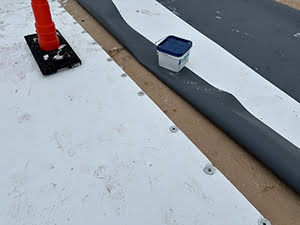
A commercial roof replacement in Minot, ND should be planned around the building’s actual condition, not appearance alone. The decision should consider recurring failures, moisture extent, insulation and substrate condition, drainage, prior repairs, and whether a dependable repair or restoration option still exists. Eagle Eye Roofing Systems serves commercial properties across North Dakota and can be reached at (701) 202-7280 to discuss a roof assessment.
Start With Evidence That Replacement Is Necessary
Replacement becomes more reasonable when problems are no longer isolated. Examples include leaks recurring in several areas, widespread surface or flashing deterioration, moisture extending through larger sections of the roof assembly, damaged insulation or substrate, drainage conditions that require broader reconstruction, or repeated repairs that are no longer providing a reliable result.
Roof age can provide context, but age by itself does not prove that a functioning roof needs replacement. Likewise, an interior stain shows where water became visible inside the building, not necessarily where it entered the roof or how far concealed moisture extends. The assessment should separate confirmed conditions from suspected hidden damage and explain what additional investigation is needed before the final scope is approved.
Compare Repair, Restoration, and Replacement
Not every roof problem requires a full replacement. A localized repair may still be reasonable when the defect is clearly defined and surrounding materials remain serviceable. A restoration approach may also deserve consideration when the existing assembly is suitable and the proposed system can address preparation, compatibility, drainage, and moisture conditions.
Eagle Eye’s commercial roofing services provide broader context for repair, restoration, and replacement options. When replacement is recommended, the proposal should explain why those less extensive alternatives are no longer reliable for the condition of this roof.
Define the Replacement Scope Before Work Starts
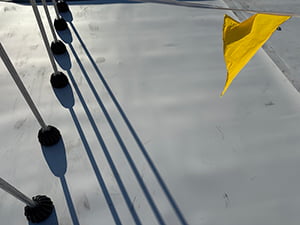
A commercial roof replacement does not always mean the same removal and rebuild sequence. Depending on the existing roof assembly, moisture findings, substrate, design requirements, and approved project approach, the scope may involve different levels of removal, insulation work, substrate repair, flashing, drainage, edge details, penetrations, and new roofing materials.
The written proposal should identify the roof areas included, removal or preparation scope, insulation work, substrate procedures, drainage-related work, flashing and penetration details, the proposed roofing system, exclusions, and the process for handling concealed conditions. Eagle Eye’s page on conducting a roof replacement service provides additional context on replacement planning.
Plan for Concealed Conditions and Change Approval
Some conditions cannot be fully confirmed until existing roofing materials are opened or removed. Wet insulation, deteriorated substrate, hidden attachment problems, or other concealed defects can change the amount of work required.
Before the project begins, the owner should know how those discoveries will be documented, priced, and approved. A clear change procedure helps prevent an unknown condition from becoming an open-ended project and gives the facility team a record of why the scope changed.
Plan Around Building Operations
Roof replacement can affect access, noise, staging, rooftop equipment, interior work areas, and normal business activity. Ask how the contractor intends to phase the work, protect occupied areas, manage materials and debris, and coordinate around deliveries, employees, tenants, or customers.
Weather planning matters as well, especially when sections of the roof assembly may be temporarily exposed. The contractor should explain the planned work sequence and temporary weather-protection approach for the actual building and forecast conditions. No single opening size, daily closure rule, or uninterrupted-operation promise fits every commercial replacement.
Review the Proposed Roofing System and Performance Claims
The replacement system should fit the building’s substrate, insulation, drainage, attachment needs, rooftop activity, penetrations, and maintenance expectations. Energy performance can improve when a project changes insulation or surface characteristics, but lower utility costs should not be guaranteed because building use, HVAC operation, insulation levels, climate, and other conditions also affect energy consumption.
Warranty terms should come from the actual written documents. Ask which obligations belong to the contractor and which belong to the roofing material or system warranty, along with exclusions, maintenance requirements, and claim procedures.
Finish With Documented Closeout
Project closeout should confirm what was completed and record any approved changes. Useful documentation can include completed-scope records, photos when provided, concealed-condition changes, punch-list resolution, warranty documents, and future maintenance recommendations.
A replacement project is easier to manage when the owner can trace the decision from condition evidence through scope, changes, installation, and closeout rather than relying on appearance or a general promise that a new roof will last for decades.
Planning a Commercial Roof Replacement in Minot, ND
For a Minot facility, a necessary roof replacement should be planned from evidence. Confirm why repair or restoration is no longer sufficient, define the replacement scope, prepare for concealed conditions, coordinate the work around building operations, and keep final documentation with the roof history. Contact Eagle Eye Roofing Systems at (701) 202-7280 to discuss the next step.
Frequently Asked Questions
Does an older commercial roof automatically need replacement?
No. Age is only one factor. The decision should also consider recurring failures, moisture, insulation and substrate condition, drainage, repair history, and whether a reliable repair or restoration scope remains available.
Does commercial roof replacement always require a full tear-off?
No. The appropriate removal and installation approach depends on the existing assembly, moisture findings, substrate, design requirements, and the approved project scope.
What should a replacement proposal explain?
It should identify included roof areas, removal or preparation, insulation and substrate work, drainage, flashing, the proposed system, exclusions, and how concealed conditions or scope changes will be approved.
Can a commercial building stay open during roof replacement?
Sometimes, but continued operations depend on access, staging, noise, weather, safety, rooftop equipment, and the work sequence. The contractor should explain the project-specific plan before work begins.